Carlo Brioschi (1781-1833), the first director of the Capodimonte Astronomical
Observatory,
began a systematic program
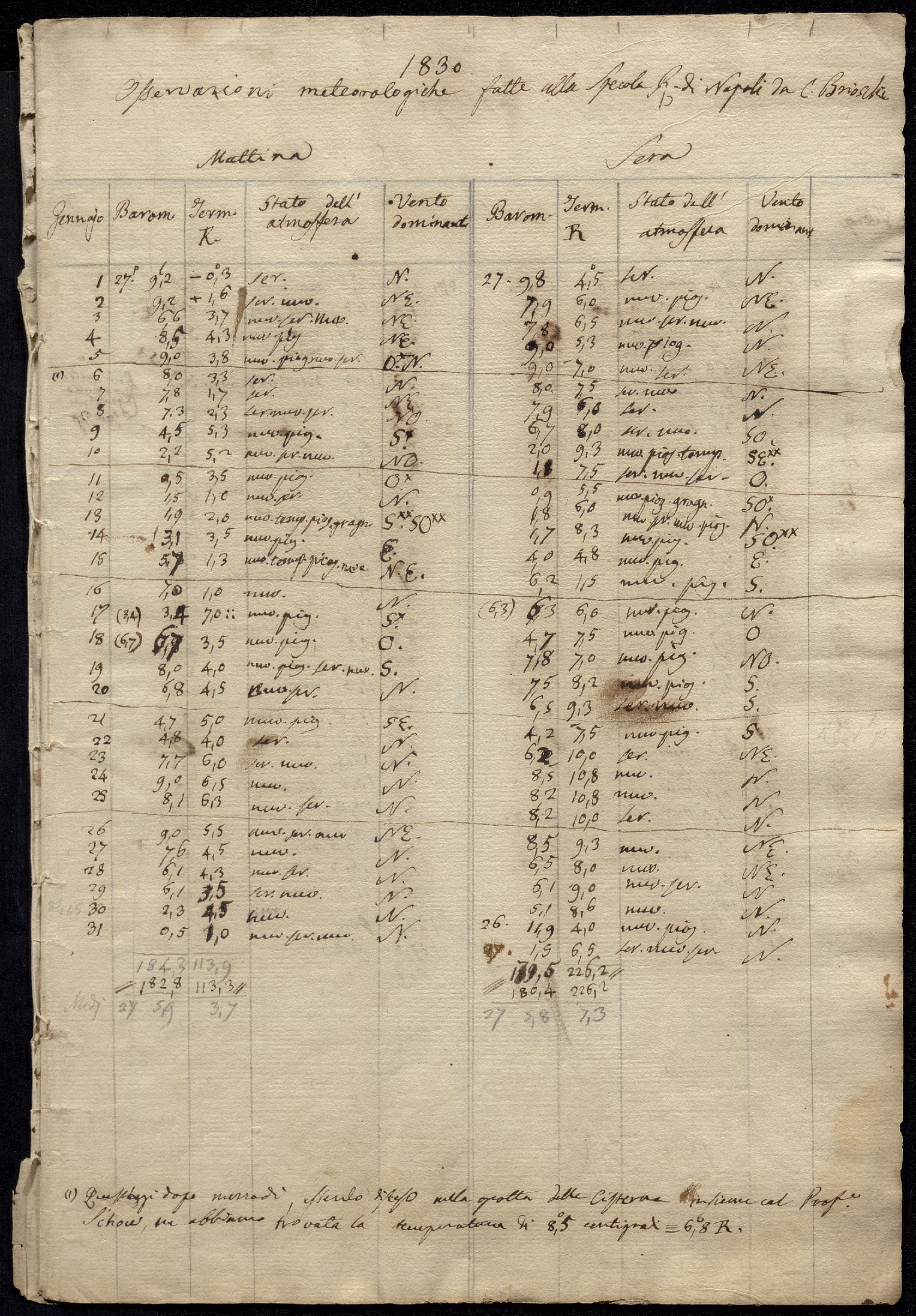
of observations as soon as he arrived in Naples. The handwritten table for January 1830
is part
of a folder recently
discovered in the Observatory’s archival repository. This folder also contains
pluviometric
records from 1832-1833 and
observation tables from the period 1848-1851, absent from the Annali civili del Regno
delle
Due Sicilie. The discovery
is of particular significance for the history of meteorological observations at
Capodimonte, as
it fills important
documentary gaps and provides new evidence for a more accurate reassessment of
nineteenth- and
twentieth-century
publications on Neapolitan climatology.
According to bibliographic sources, Brioschi began his meteorological observations in
1821,
publishing the monthly
results - i.e., summaries without the daily data tables - in the Calendario della
reale
Specola di Napoli between 1821
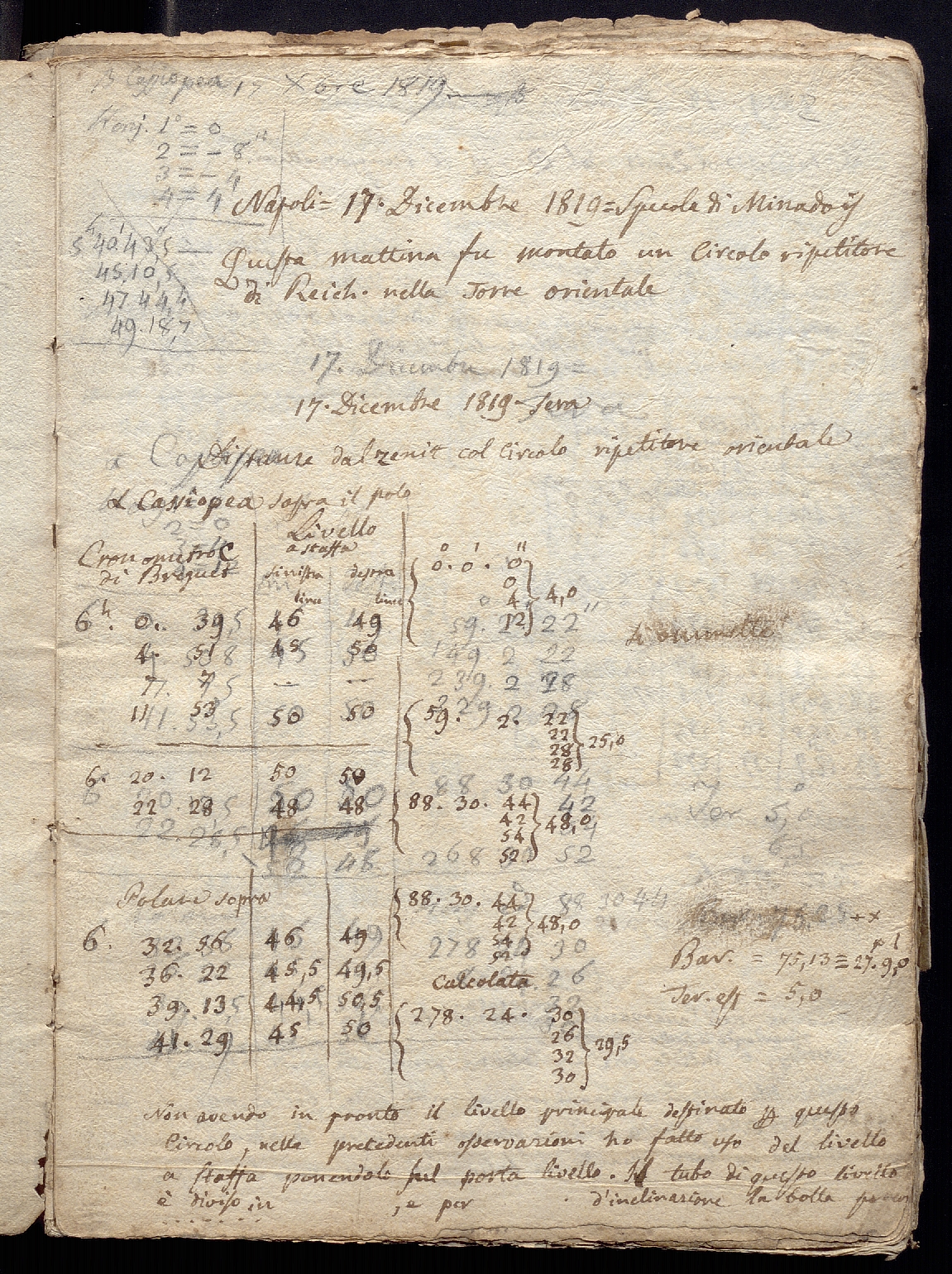
and 1832. In fact, from the evening of his first astronomical observation at Capodimonte
on
December 17, 1819, Brioschi
had already been recording temperature and pressure values in his diaries.
However, interest in the study of atmospheric phenomena and climatic variations in the
Neapolitan capital has far older
roots. Among the earliest figures to engage in this field was Niccolò Cirillo
(1671-1735), a
physician at the Ospedale
degli Incurabili, who cultivated naturalistic interests with particular attention to
botany and
meteorology. He deepened
his knowledge by reading the leading scientific journals of the time, such as the
Philosophical Transactions, which he
regularly received from London. Beginning in August 1724, he established direct contact
with the
Royal Society,
regularly sending the meteorological data collected in Naples in the form of the
Diarium
meteorologicum Neapolitanum,
thus contributing to the international observation network promoted by the English
society.
Another prominent figure was Ascanio Filomarino (1751-1799), “gentleman of the Chamber”
to King
Ferdinand IV, collector
of minerals and historical views of Vesuvius’s eruptions. Filomarino set up a laboratory
in his
residence equipped with
instruments for seismic measurements and organized meetings and discussions among
scholars. His
interest in meteorology
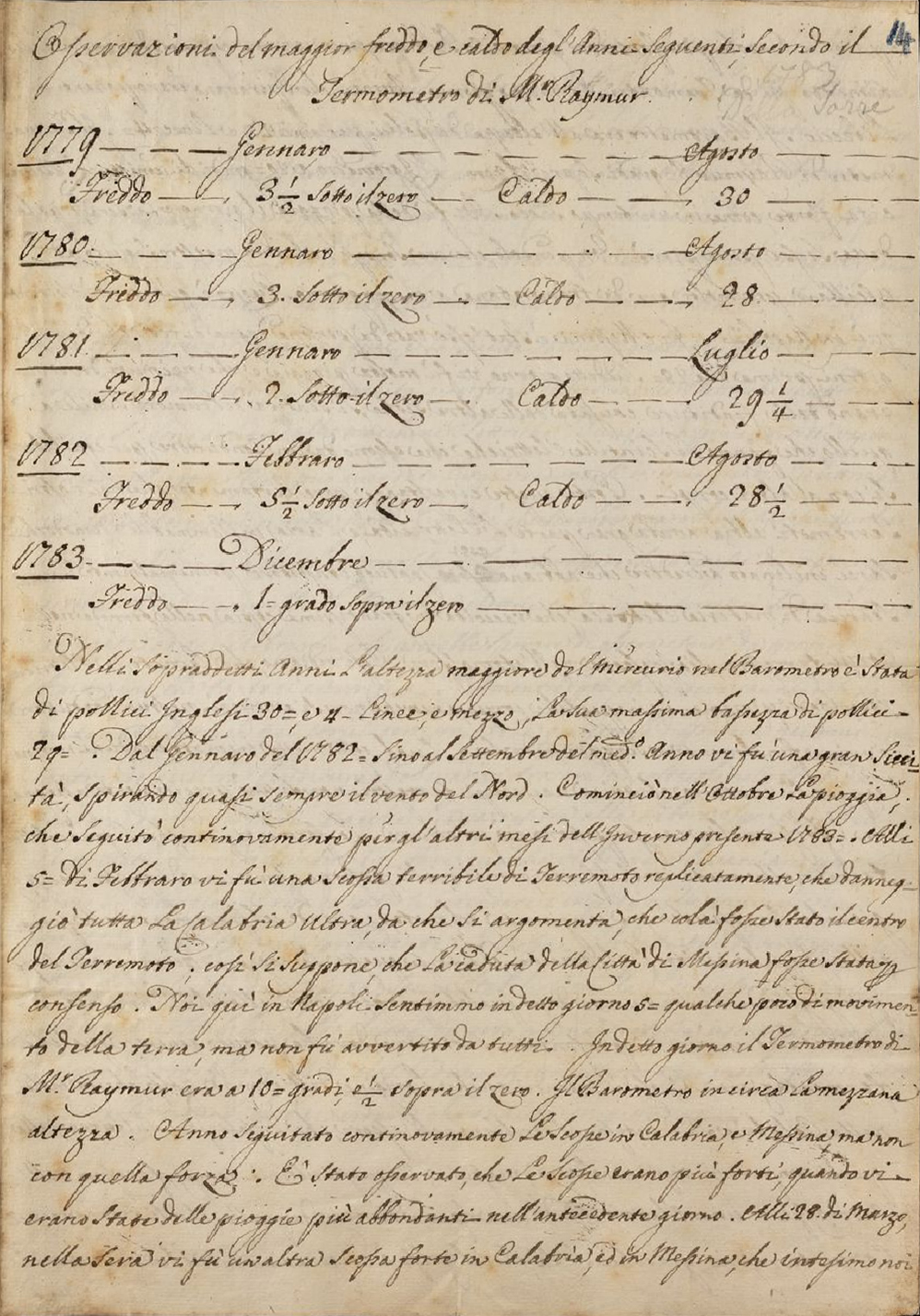
is evidenced by an unpublished letter sent to the Royal Society, Osservazioni del
maggior
freddo, caldo degl’anni
seguenti, secondo il termometro di M.r Raymur (“Observations of the greatest
cold and
heat of the following years,
according to Mr. Réaumur’s thermometer”), in which he reports his barometric,
hygrometric, and
thermometric observations
recorded in Naples between January 1779 and December 1783, using a Réaumur
thermometer.
In the late eighteenth century, Giuseppe Cassella (1755-1808) was a central figure in
astronomical studies in the
Kingdom of Naples. After completing his astronomical and experimental training in Padua
at the
Observatory of Abbot
Toaldo, in 1786 Cassella was recalled to Naples to teach nautical astronomy at the Royal
Naval
Academy and mechanics at
the Royal College of Artillery. In 1791 he obtained approval to build an observatory in
the
Palazzo dei Regi Studi
(Palace of the Royal Studies), a project later abandoned due to the limited view of the
horizon.
Despite Giuseppe Maria
Giovene’s (1753-1837) proposals to create a meteorological society based in Naples,
which was
never realized and the
abandonment of the observatory project, Cassella continued astronomical and
meteorological
observations for many years.
Between 1792 and 1797, he published brief reports on the atmospheric conditions of the
capital
in the Calendario e
notiziario della corte, indicating the coldest and warmest days of the year
along with
the maximum and minimum values
recorded by the barometer.
With the advent of the French government, King Joseph Bonaparte promoted the revival of
scientific studies and, in 1807,
established the Astronomical Observatory at the former Monastery of San Gaudioso
Observatory,
entrusting it to Cassella.
The building was intended to house both the astronomical observatory and a
meteorological
station, as well as a chemical
laboratory. After Cassella’s death, his brother Angelo continued the meteorological
activities,
publishing in the
Calendario dell’anno 1810 pel Regno di Napoli 1810 fatto nell’Osservatorio di S.
Gaudioso, the “Meteorological Reports
for the ”Year 1808.
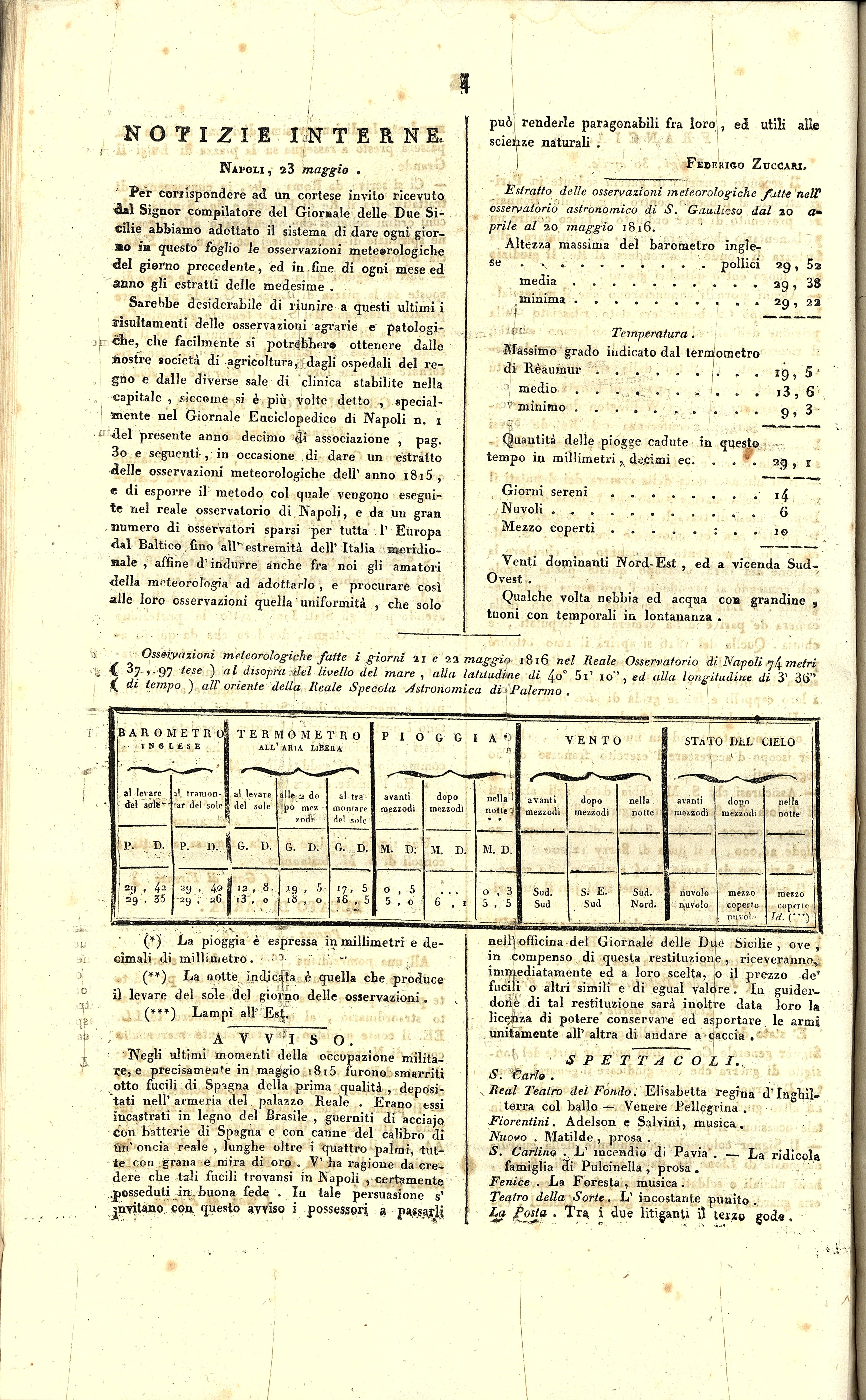
Cassella’s scientific legacy was continued by Federigo Zuccari (1784-1817), who in 1812
initiated the construction of
the new Observatory at Capodimonte. At San Gaudioso, Zuccari continued to systematically
record
atmospheric data
according to the criteria set by the Aargauische Naturforschende Gesellschaft, joining
the
European network of
meteorological observatories promoted by the Swiss Society. His publications in local
journals and newspapers, such as
the Giornale enciclopedico di Napoli and the Giornale delle Due Sicilie,
marked
the
beginning of a modern observational
tradition, interrupted only by his death in 1817 and resumed with the opening of the new
Observatory in 1819.
___Emilia Olostro Cirella
References
Calendario di Napoli per l’anno 1823 settimo del Regno di
Ferdinando
I (1822). Napoli: nella Stamperia del Giornale del
Regno delle Due Sicilie.
Canino, V. (1889). Il clima di Napoli. (Da osservazioni
meteorologiche
fatte nel R. Osservatorio astronomico di
Capodimonte). 1821-1887, Roma: Stabilimento Bontempelli.
Olostro Cirella, E. (1995). “Per una storia dell’Osservatorio
Astronomico
di Capodimonte: gli anni dal 1735 al 1812”,
Memorie della Società Astronomica Italiana, 66(4), pp. 795-812.
___
___