James Jurin and the Royal Society’s meteorological correspondence network
The XVIII century was characterized by improvements in meteorological instruments and a significant
increase in the
number of scholars conducting regular observations. Meteorology became increasingly organized, and
there were many
attempts to establish international networks of meteorological observatories. In this regard, the
Royal Society of
London played a leading role from its founding in 1660. The strength of its broad and multifaceted
activity consisted
essentially in its extensive use of scientific correspondence.
Communications produced by
observers outside London soon
became part of the Society's daily practice, and several members undertook projects dedicated to
collecting data and
writing technical reports on specific topics. James Jurin, who served as secretary of the Society
from 1721 to 1727,
established an international network of observatories dedicated to the collection of meteorological
data, presenting his
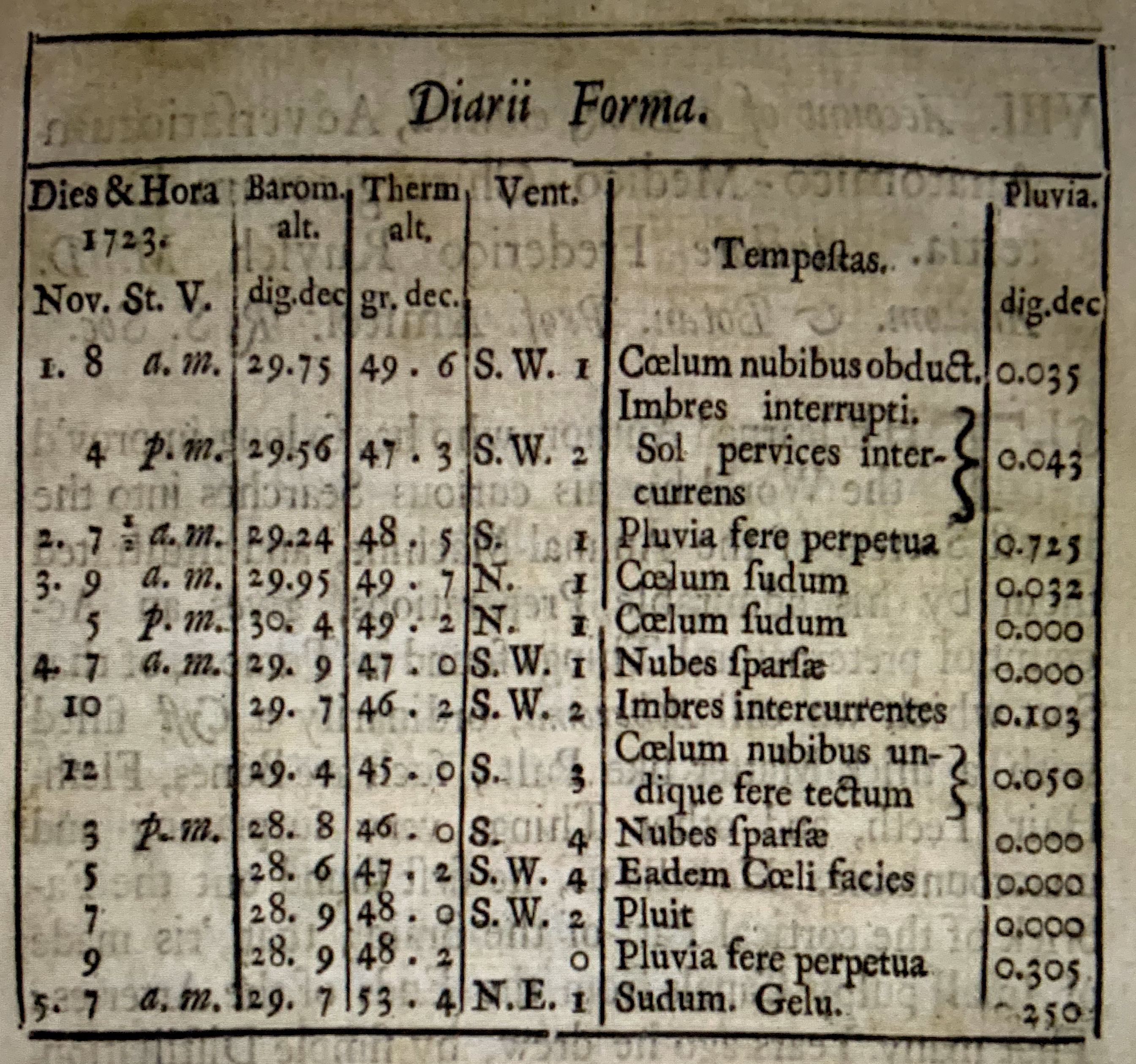
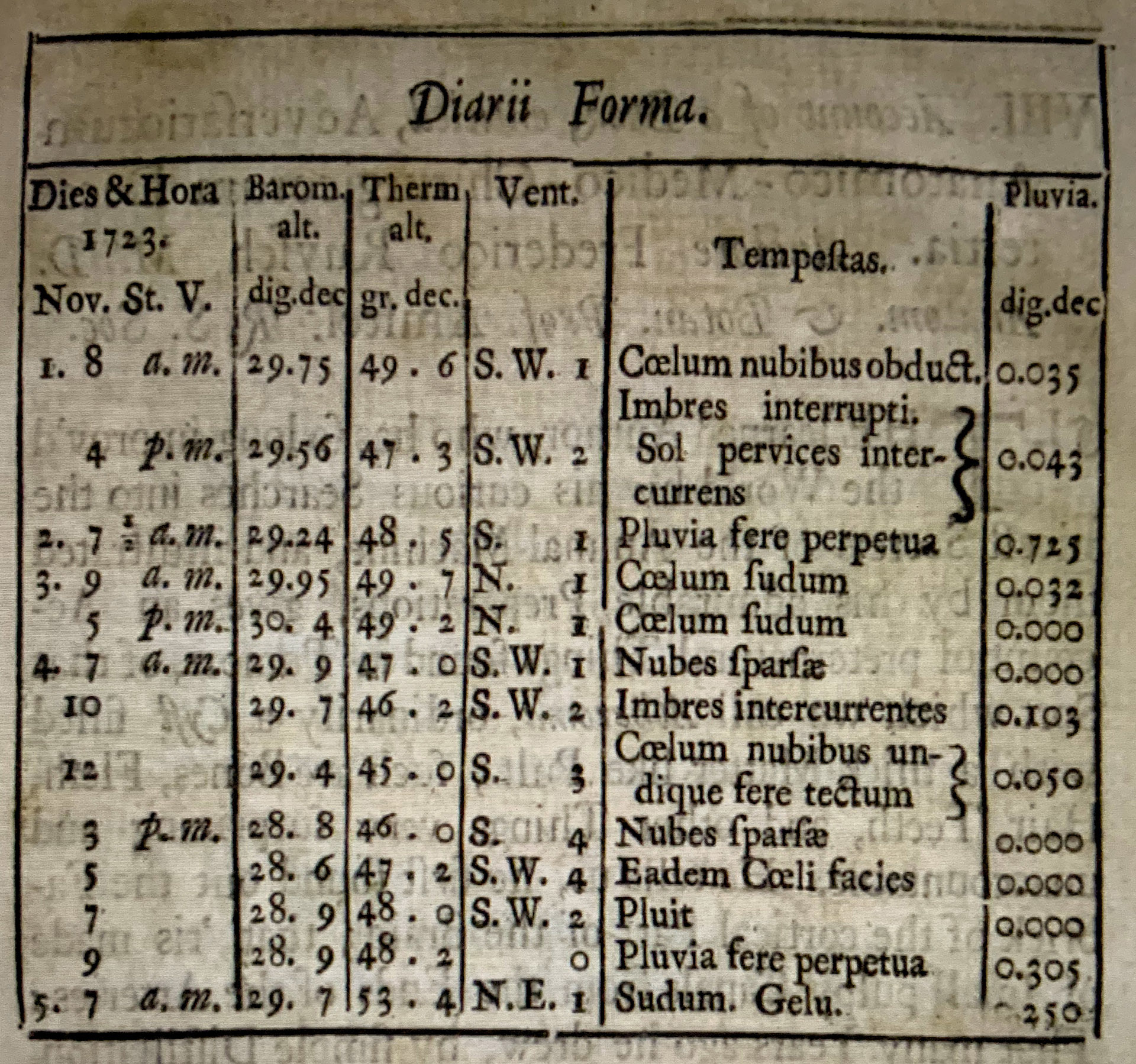
ambitious program on December 12, 1723, later published in the Society's Philosophical Transactions.
Jurin's proposal
also included a template for the correspondents to follow in compiling their reports: the underlying
idea was to
standardize observations, instruments, and measurement methods. Consequently, participants were
asked to record
observations twice a day, including temperature, pressure, wind direction and intensity,
descriptions of clouds, and the
amount of rain and snow. The main challenge was obtaining uniform measurements. To address this
problem, Jurin obtained
funding from the Council of the Royal Society to purchase eighteen Hauksbee thermometers to send to
foreign
correspondents, but, unfortunately, his attempt was unsuccessful.
Jurin's network included observatories in Uppsala, St. Petersburg, Berlin, Leiden, Naples,
Luneville, Boston, and many
cities in Great Britain, which regularly sent daily reports on atmospheric conditions. The
correspondent from Naples was
the physician and botanist Niccolò Cirillo, who joined Jurin's network in 1723, regularly carrying
out his
meteorological observations until his death in July 1735.
___Salvatore Esposito & Adele
Naddeo
References
Jurin, J. (1723). “Invitatio ad observationes meteorologicas communi consilio
instituendas”,
Philosophical Transactions
of the Royal Society of London, 32 (379), pp. 422-427.
Patterson, L. D. (1951). “Termometers of the Royal Society, 1663-1768”,
American Journal of
Physics, 19, pp. 523-535.
Rusnock, A. (1999). “Correspondence networks and the Royal Society,
1700-1750”, The British
Journal for the History of
Science, 32, p. 155-169.
___
___