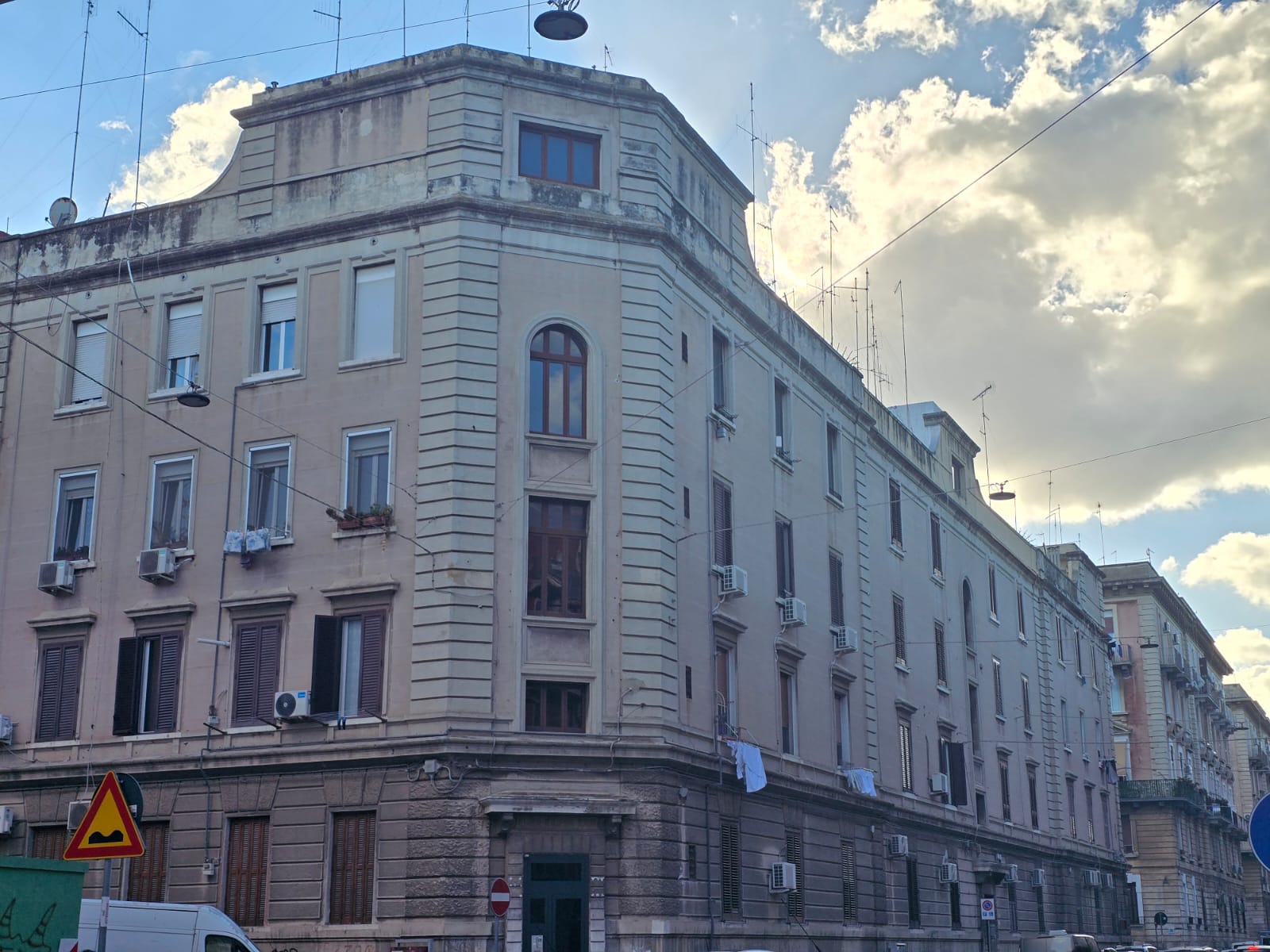
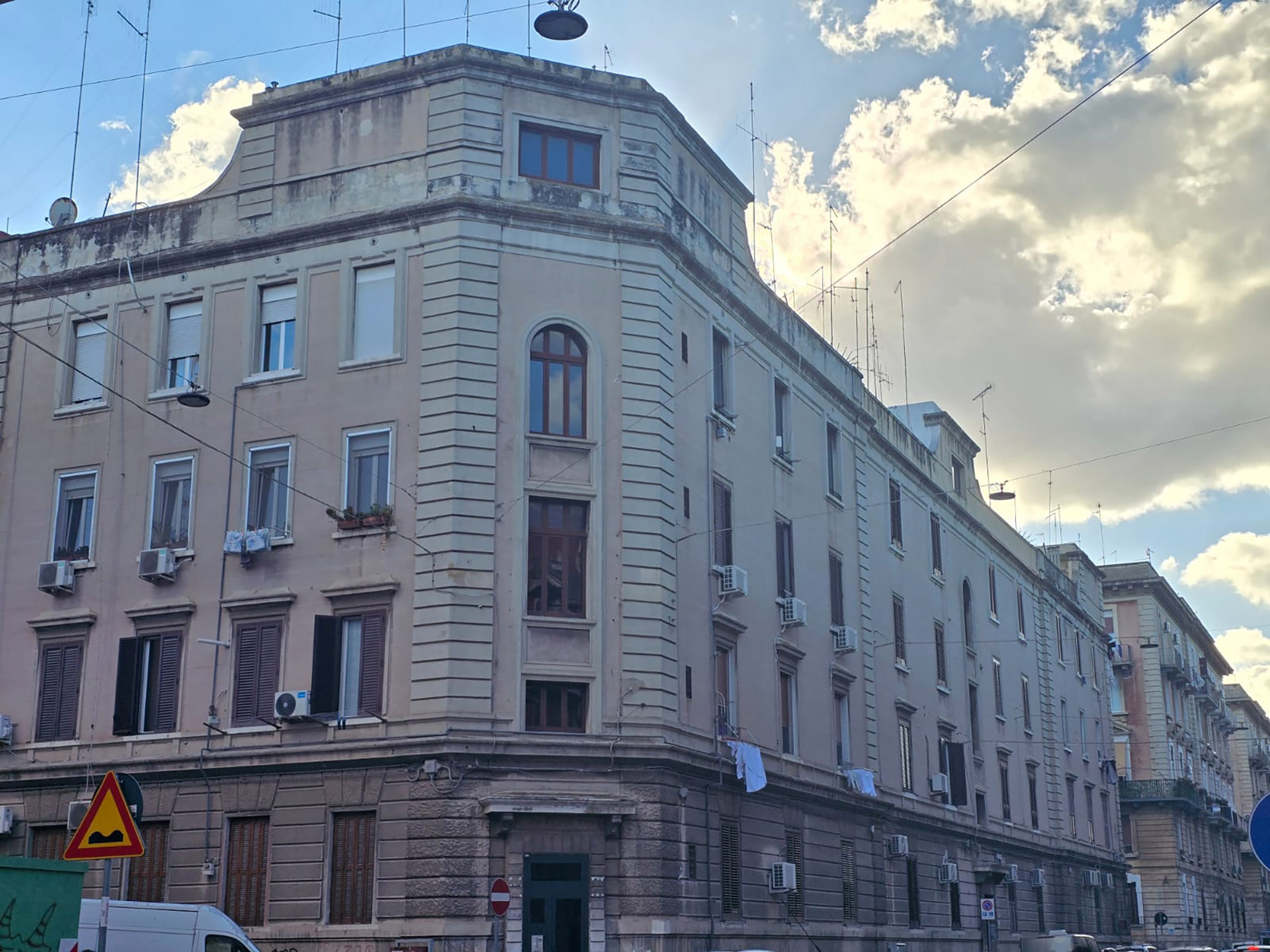
The ‘Flood Victims’ Housing Block’, seen from Via Nicolai at the corner with Via Libertà in Bari
Credits: Roberto Rizzi, Università of Bari Aldo Moro
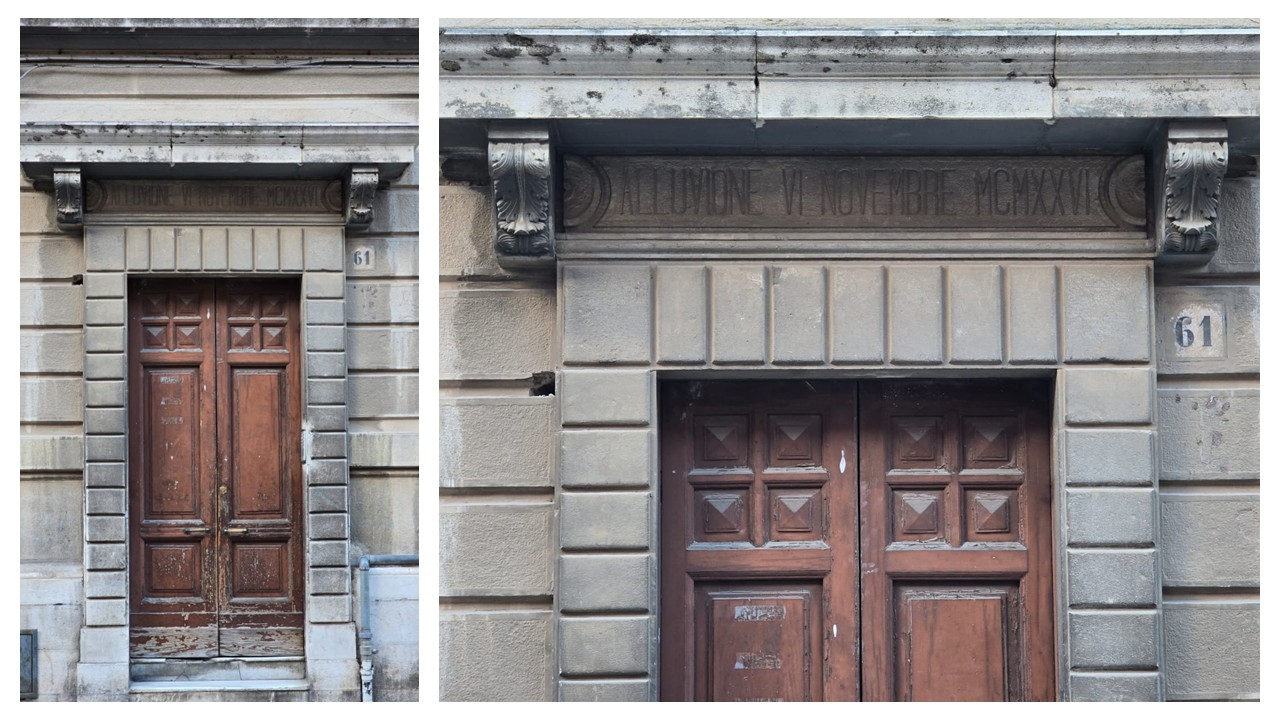
Detail of the architrave bearing the inscription “Alluvione VI novembre MCMXXVI”, at number 61
Credits: Roberto Rizzi, Università of Bari Aldo Moro
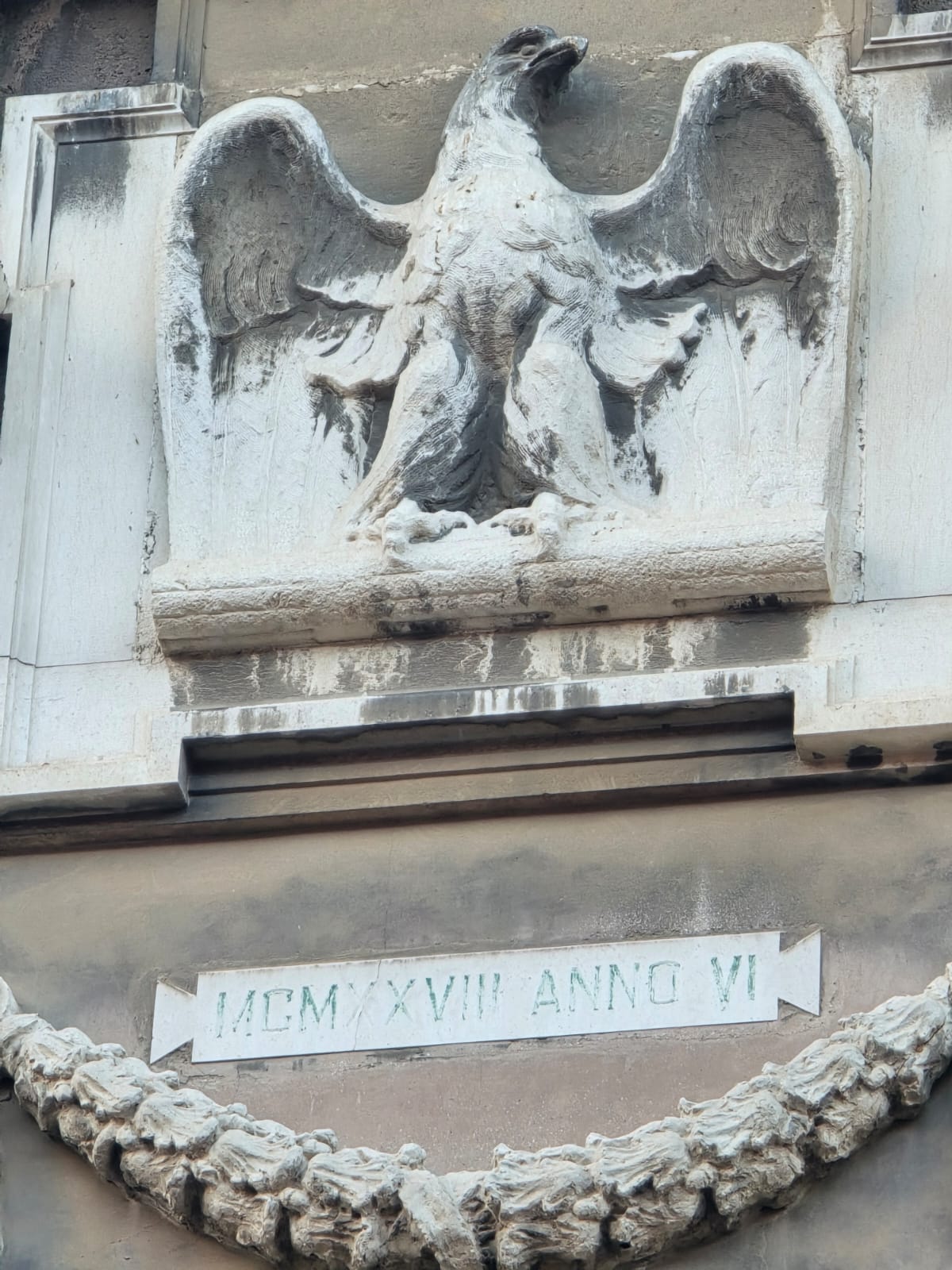
Detail of the eagle on the side of the building overlooking Via Libertà, opposite the former Manifattura dei Tabacchi
Credits: Roberto Rizzi, Università of Bari Aldo Moro
;
SOUTH RISK
From data collection to monitoring intervention. A southern history
Hecate in the Sky
University of Bari Aldo Moro
The “Casa degli Alluvionati” in Bari. Stone, Memory, Propaganda
On every stone lintel, above each doorway, the same solemn inscription is carved in Roman capitals: “Alluvione VI
novembre MCMXXVI.” It is not merely a date, but a wound in stone – a scar of memory. Those words greet anyone who passes
through the entrances of the large building occupying the block between Via Nicolai, Via Martiri d’Otranto, and Via Don
Bosco, in Bari’s Libertà district. This is the so-called Casa degli alluvionati – the “House of the Flood Victims” –
built between the late 1920s and early 1930s to shelter those who had lost everything between the 5th and 6th of
November 1926. Nineteen dead, fifty injured, whole blocks submerged: the city awoke in mud. Yet solidarity soon took
architectural form. The Istituto Fascista Autonomo per le Case Popolari commissioned engineer Giuseppe Favia to design a
large residential block for the homeless survivors of the flood. The result was an imposing, self-contained structure –
a kind of citadel: five storeys, ten portals, and long, disciplined rows of windows. Its rigidity is softened by four
chamfered corners, each with twin entrances bearing the same epigraph: “Alluvione VI novembre MCMXXVI.” Nearly a century
later, the building still preserves the marks of fascist architecture: monumental proportions, geometric austerity, and
a symbolic severity. On the façade facing the former tobacco factory stands a marble aedicule. Between two weathered
columns crowned with the Savoy coat of arms, an eagle dominates the scene – ancient Roman emblem and, under the regime,
sign of renewed imperial ambition. On the opposite side, an iron gate opens onto an interior courtyard, a small enclosed
garden. Yet even here, greenery is framed by two fasci littori carved into the gateposts, and a length of rusting barbed
wire stretches across the top – an unintentional image of what this building embodied: an architecture conceived to
protect, yet also to contain. Those who once crossed its thresholds carried in their eyes the memory of the rising
waters that had swept everything away. The families rehoused here entered new dwellings born from loss. Each lintel
reminded them, in unyielding stone, of the date of the flood – a silent witness above their heads. Thus the Casa degli
alluvionati became not only a refuge but a monument: a response in stone to the liquid menace of the waters. And behind
the regime’s rhetoric – which sought to turn suffering into monumentality – endures the human truth of those who lived
within these walls: men and women who had learned, in Bari as throughout Apulia, that rain can be salvation or ruin,
promise or condemnation.
___Stefano Daniele &
Francesco Paolo de Ceglia
South Risk
From data collection to monitoring
interventions and
risk prevention
Project realized by:
University of Bari Aldo Moro
INAF - Astronomical Observatory of Capodimonte
University of Naples Federico II
University of Messina
PROGETTO SOUTH RISK © 2026 ALL
RIGHTS
RESERVED
The exhibition is realized for the project:prin
pnrr
South-Risk
From data collection to monitoring
interventions
and
risk prevention
A southern history
P2022TA5M8
