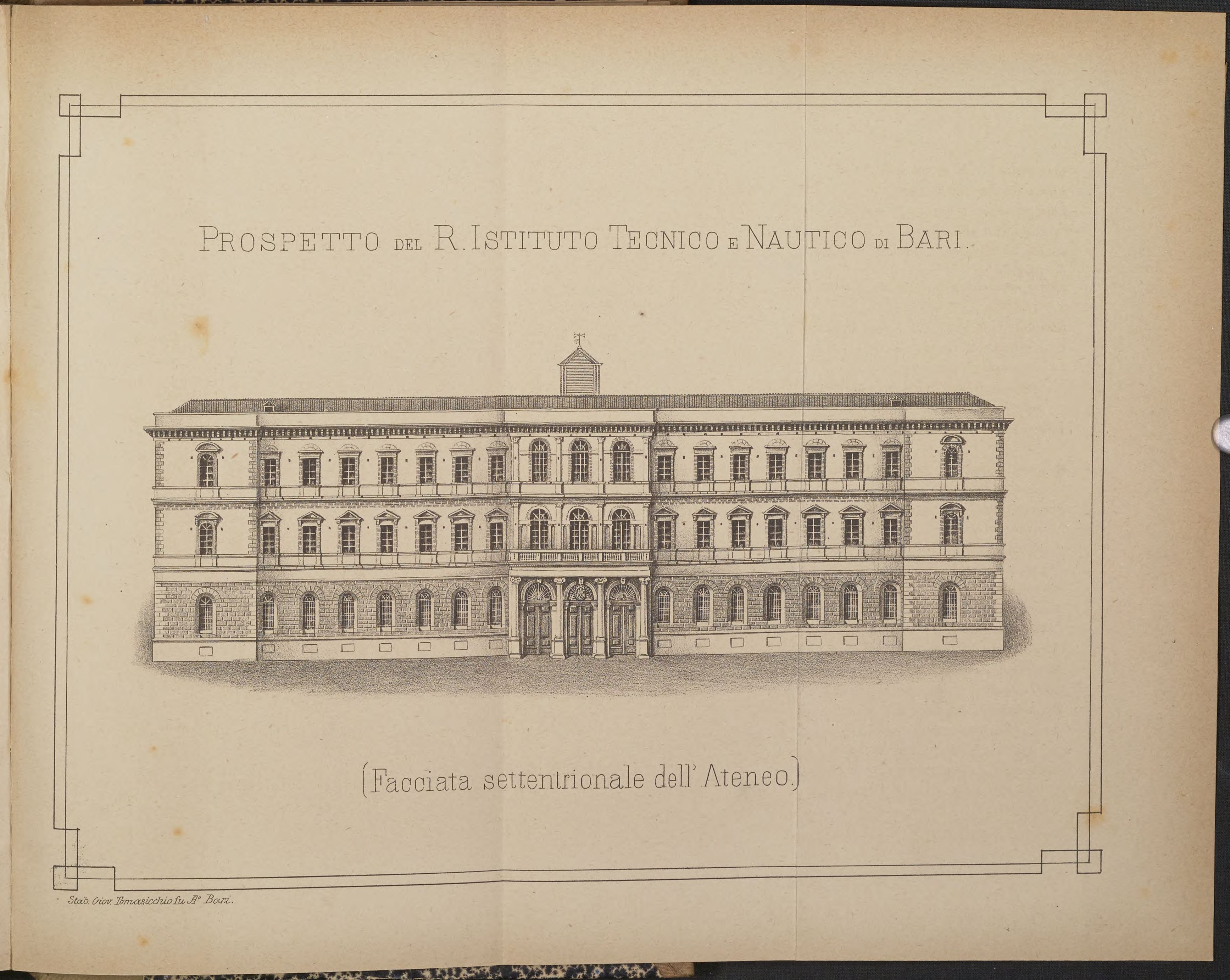
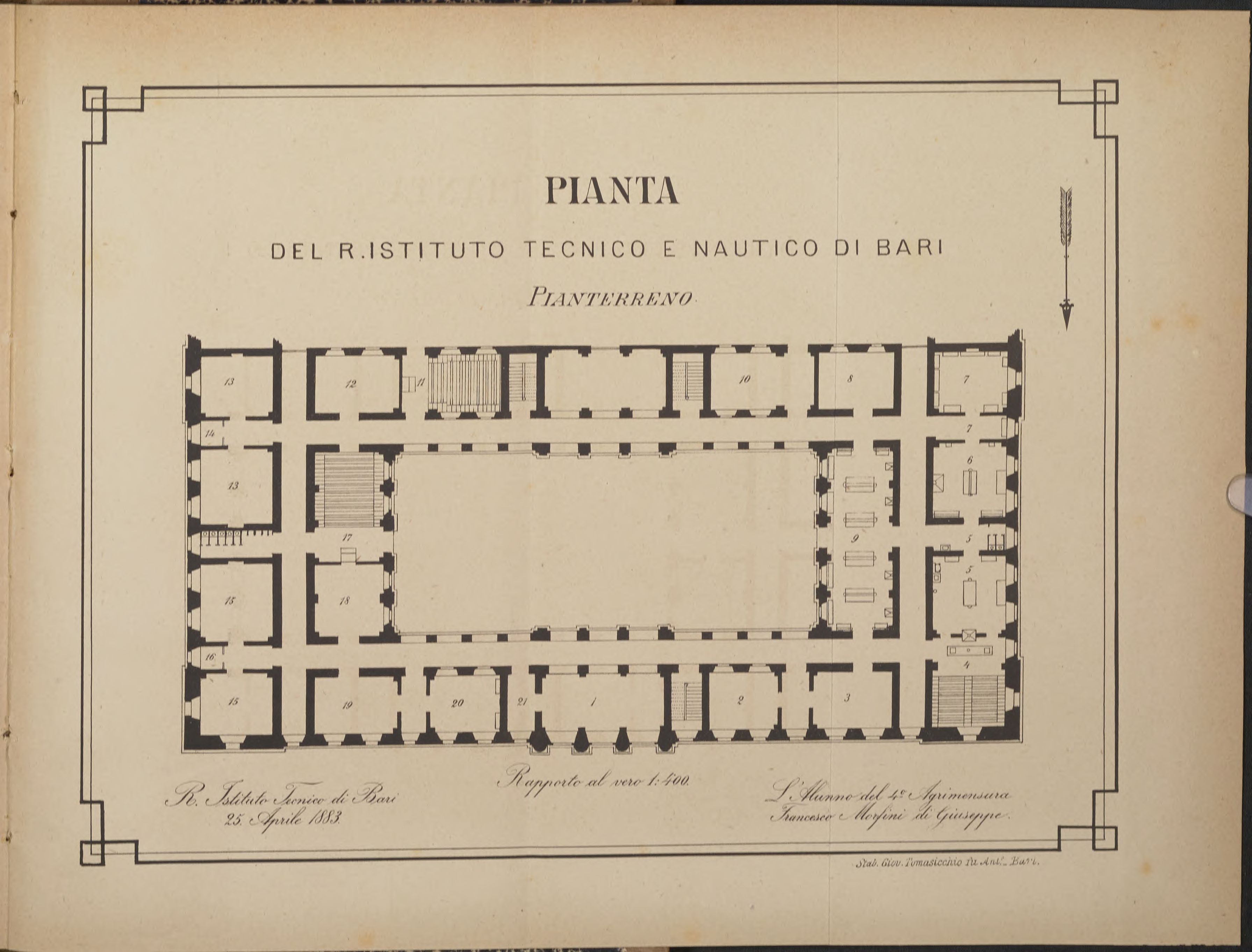
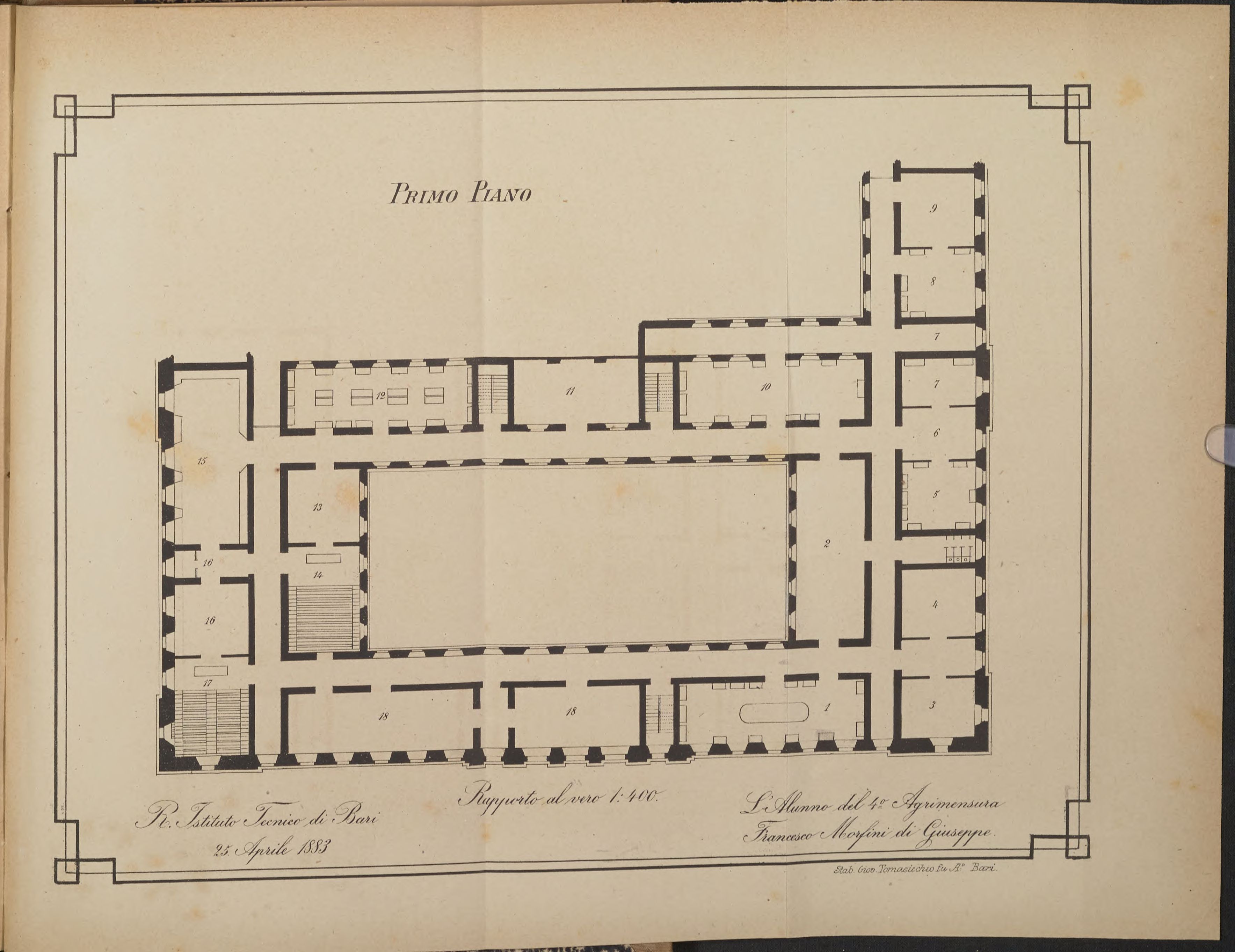
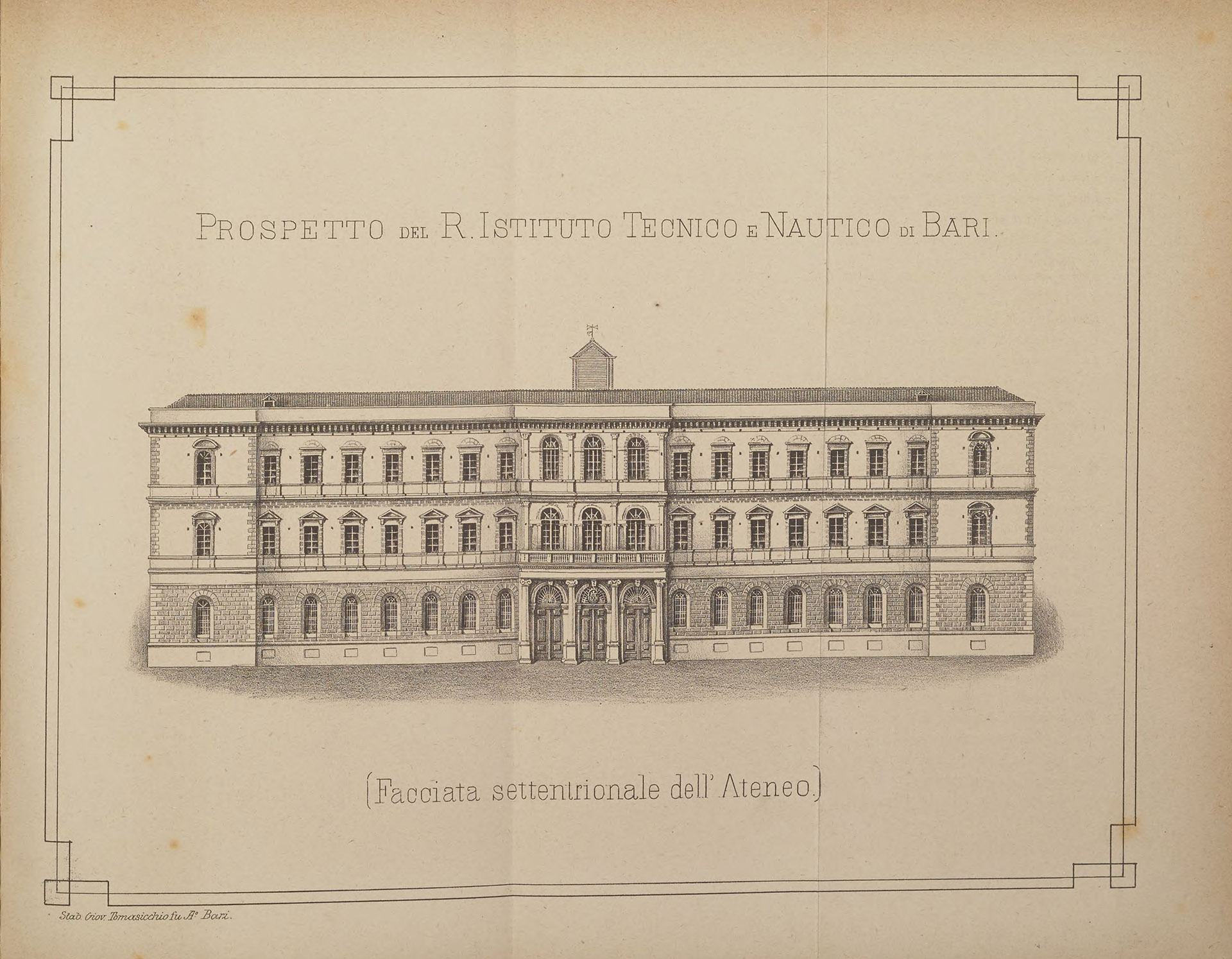
At the Heart of the Ateneo. The Regio Istituto Tecnico e Nautico of Bari
In mid-nineteenth-century Bari, technical knowledge finally found a permanent home. In 1866, the
Istituto Tecnico
Provinciale was founded, soon joined by the older Scuola Nautica, established in 1858.
Two distinct yet complementary
institutions, they were eventually united by the Province into a single body: the Regio
Istituto
Tecnico e Nautico. With
the completion and official approval of the renovation works at the Palazzo Ateneo (1881–82),
the Institute moved into
the building: first occupying the ground and first floors of the north wing, and, after 1887,
extending to the second
floor as well. The move marked a leap forward – not only for technical and nautical education
but for the city itself,
which now possessed a true training infrastructure serving its economy and maritime industry.
The Institute became a
small citadel of practical knowledge: laboratories of physics and chemistry, rooms for natural
sciences, construction
and practical geometry, drawing schools, and spaces dedicated to agronomy. The nautical section
included classrooms for
astronomy, navigation, hydrography, and workshops for machinists. Over a thousand square metres
of instruments and
models turned theory into tangible experience. This period of growth was guided by Onofrio
Porcelli (1846–1906), a
mathematician from Bari educated in Naples, and translator — first with his mentor Giuseppe
Battaglini — of Isaac
Todhunter’s algebra manuals, which introduced a modern didactic approach to the subject in
Italy. As headmaster from
1883, Porcelli combined scientific rigour with administrative vision: he secured funding,
enriched the laboratories, and
renewed the curriculum. In the obituary dedicated to him, his colleagues remembered him as
“calm and serene,
considerate, tolerant, benevolent (calmo e sereno, riguardoso, tollerante, benevolo),”
yet he was also an indefatigable
builder of an institution that attracted students from across Apulia. Over time, the Institute
faced new challenges: its
official recognition as equivalent to government schools (1872); the introduction of three main
study sections; and, in
1908, the admission of the first female students. In 1917, the Nautical School passed under the
control of the Navy, and
by 1921 it had become independent. The Gentile Reform of 1923 reshaped the educational
programmes, and in 1924, with the
founding of the Regia Università Adriatica “Benito Mussolini”, the Istituto Tecnico began to
vacate the Ateneo,
gradually relocating until its new building was inaugurated on 6 March 1930, under the name
Giulio Cesare. In 1970, the
surveying branch proudly restored its historic title: Pitagora.
___Stefano Daniele & Francesco Paolo de
Ceglia
References
Annuario del Real Istituto Tecnico “Pitagora” Bari, (1924). Anno
Scolastico 1923-24.
Gabrieli, A. (1906). “Discorso in memoria del Cav. Uff. Onofrio
Porcelli”, Annuario del Regio Istituto Tecnico e Nautico
di Bari, anno 1905, pp. I-XXIV.
.
Campanile, B. (2007). “Onofrio Porcelli, l’algebra moderna introdotta
da un preside”, in de Ceglia, F.P. (a cura di),
Scienziati di Puglia. Secoli V a.C.-XXI d.C. Bari: Adda, pp. 316-317.
___
___