Between Scylla and Charybdis: science and myth in the strait of Messina
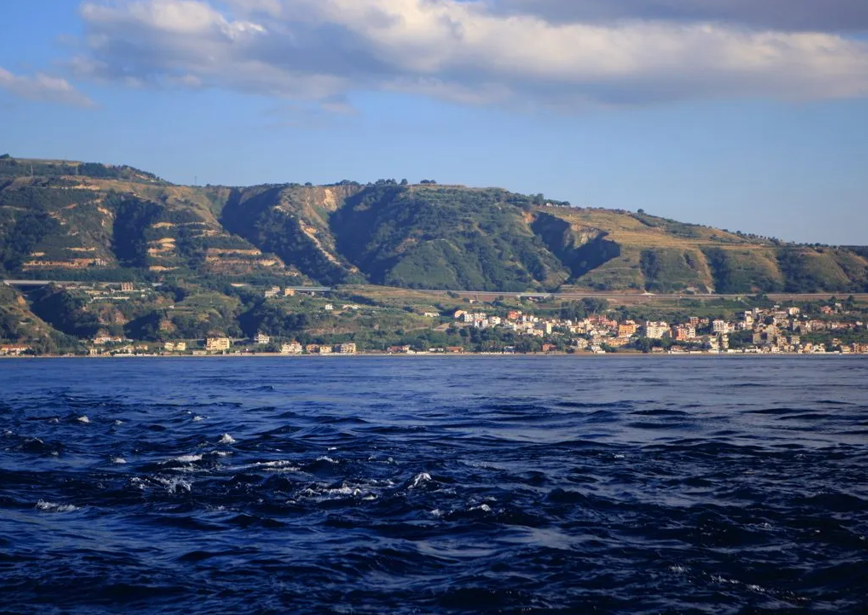
The Strait of Messina, a vital maritime corridor separating the Italian peninsula from Sicily,
has always been an
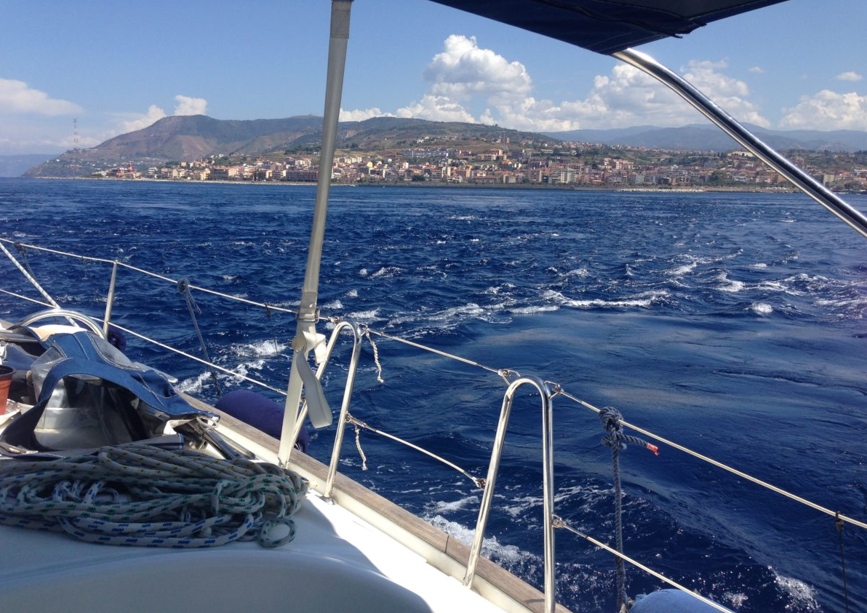
extreme test for sailors due to its exceptional and complex hydrodynamics. The indomitable force
of these waters is
echoed in Greek mythology with the figures of Scylla and Charybdis, two monsters that
personified the physical dangers
of the Strait.
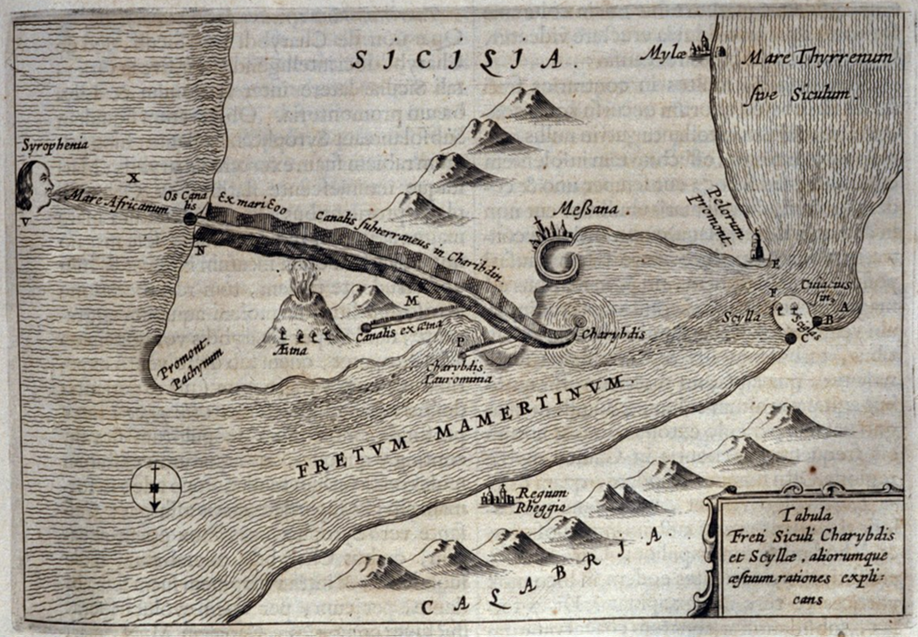
The episode narrated in the Odyssey reflects the ancient perception of marine dangers. This
connection was formalized in
the 17th century by Athanasius Kircher's geographical-mythological engraving.
However, the turbulence once explained by mythology now finds a precise interpretation in
oceanographic models. The
extraordinary dynamics of the Strait of Messina are mainly caused by the gravitational forces of
the Moon and Sun, which
trigger tidal motion. This phenomenon occurs in six-hour cycles, alternating four main flows
with periods of “calm.” The
currents are divided into rising (south → north) and falling (north → south), reaching maximum
intensity during the new
moon and full moon. The complex hydrodynamics are further fueled by the meeting of Tyrrhenian
and Ionian waters of
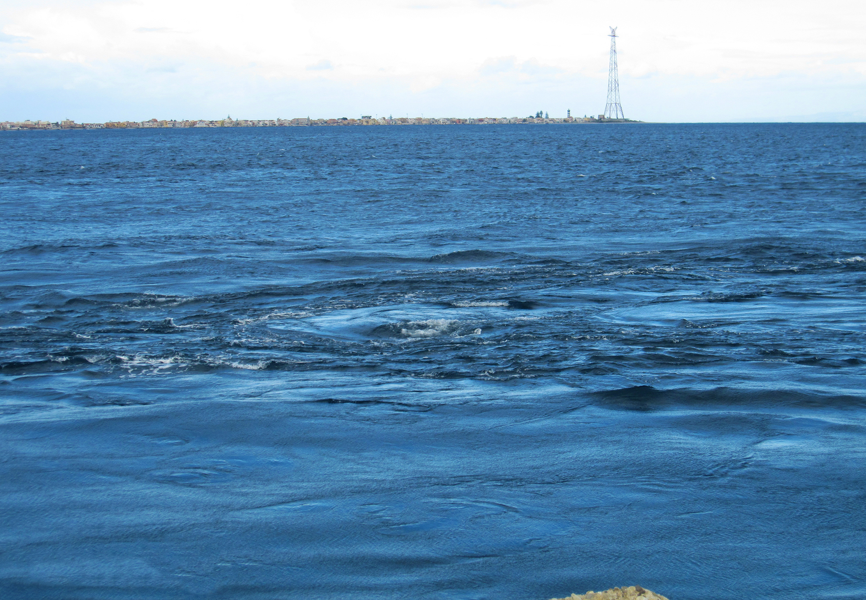
different densities and temperatures, which gives rise to the famous “garofali” (surface
vortices). Density
(thermal-saline) and drift (wind) currents also play a role. The combination of all these flows
makes the Strait an
extremely turbulent environment, with speeds that can reach 20 km/h.
___Katia Aragona, Maria Teresa Caccamo,
Salvatore Magazù
References
Defant, A. (1940). “Scilla e Cariddi e le correnti di marea nello Stretto
di Messina”, Geofisica Pura e Applicata, 2,
pp. 93-112.
Longo, F. (1882). Il Canale di Messina e le sue correnti. Messina:
Ribera.
De Domenico E. (1987). “Caratteristiche fisiche e chimiche delle acque
nello Stretto di Messina”, in Geronimo, I,
Barrier, P. & Mantenat Ch. (eds.) Le Detroit de Messine, Paris: Institut géologique
Albert
de Lapparent, pp. 225- 235.
___
___