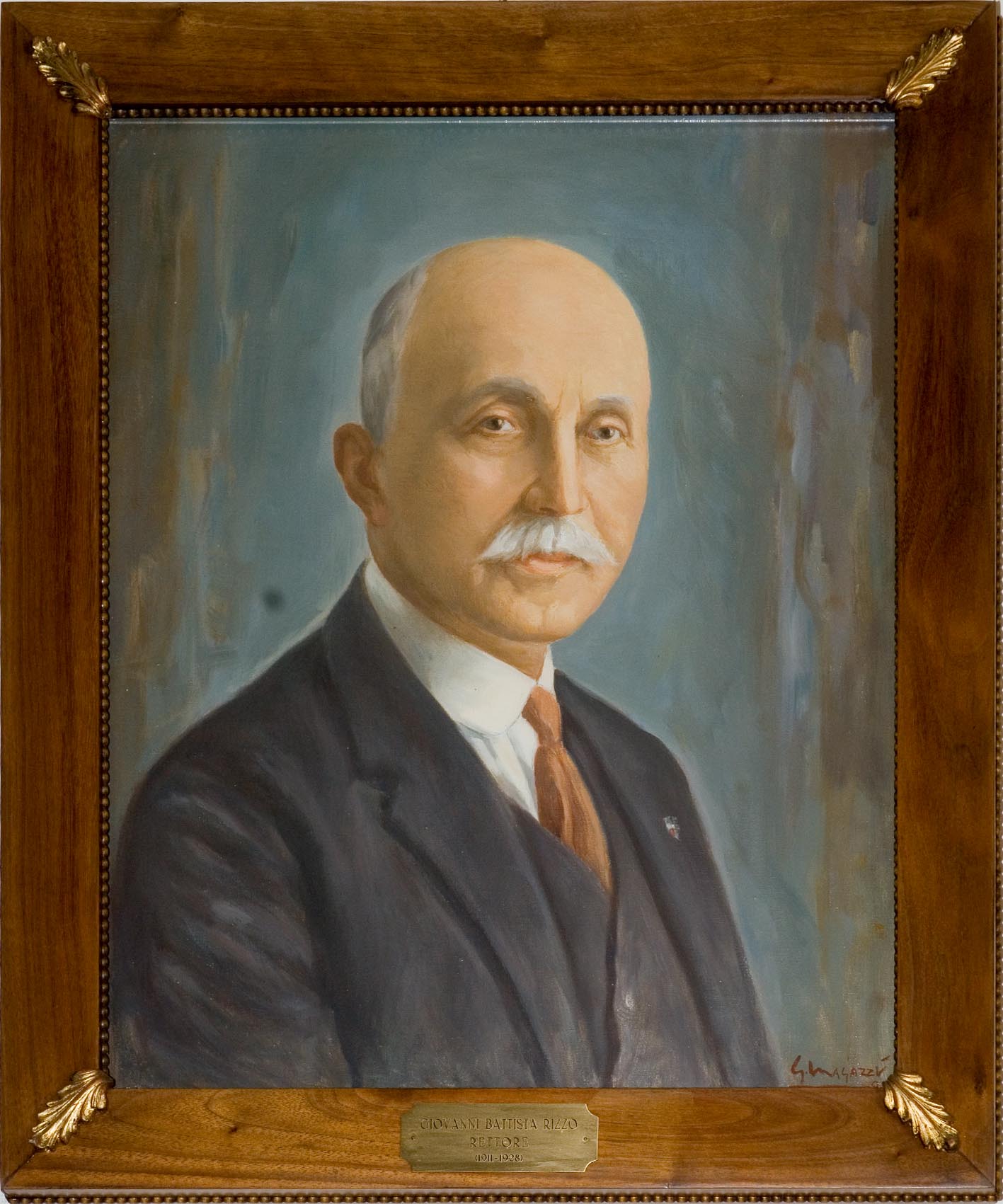
Giovanni Battista Rizzo: The Vision of an Earth Physicist Between the Nineteenth and Twentieth
Centuries
Giovanni Battista Rizzo (1863-1945) stands as one of the most significant figures in the history
of Italian terrestrial
physics. Born in Monastero di Vasco, in Piedmont, into a humble family, his determination and
early aptitude allowed him
to pursue university studies at the Royal University of Turin. There he trained as a physicist
and quickly became an
assistant at the Astronomical Observatory directed by Francesco Porro, a figure who strongly
influenced his early
scientific direction. From his youth, Rizzo devoted himself to pioneering research on absorption
spectra, solar
radiation measurements, and high-altitude meteorology, collaborating with international
institutions and conducting
fieldwork on Monte Rosa to measure solar intensity and the so-called solar constant.
His career took a decisive turn when he moved to Messina in the early twentieth century.
Appointed first to the Chair of
Terrestrial Physics and later to that of Experimental Physics, Rizzo assumed the directorship of
the Meteorological and
Geodynamic Observatory of Messina in 1904. Immersed in this new Mediterranean context, he
increasingly focused on
geodynamics and seismology, disciplines then undergoing rapid development. The earthquakes of
1905 and, above all, the
catastrophic event of 28 December 1908 profoundly shaped his personal and scientific trajectory.
A direct witness to the
tragedy, Rizzo was among the first to propose an energetic interpretation of earthquakes,
challenging the purely
descriptive approach of the Mercalli scale and anticipating the later need for a standardized
physical measure of
magnitude, which would only be formalized decades afterward. Beyond his scientific relevance,
Rizzo played a decisive
institutional role within the city of Messina. Appointed Rector of the University in 1911, a
position he held until
1928, he led the complete reconstruction of the Ateneo after the earthquake. His tenure was
marked by strategic vision
and exceptional administrative commitment: under his leadership, the University was rebuilt from
the ground up and
reorganized, regaining a central cultural role in both the city and the region. He also promoted
the establishment of
new scientific institutes, including the School of Veterinary Medicine. In the later years of
his career, after
relocating to Naples, Rizzo taught Terrestrial Physics and contributed numerous entries to the
Enciclopedia Italiana
Treccani, especially in the fields of meteorology and atmospheric physics. Even in his mature
scientific years, he
remained attuned to the evolution of the discipline, clearly recognizing the need for an
integrated approach to
atmospheric, magnetic, and seismic phenomena. A figure of rare balance—combining academic rigor,
scientific insight, and
institutional responsibility—Giovanni Battista Rizzo left a profound legacy, though long
overshadowed by the dramatic
historical events of his era. His contributions to meteorology, geophysics, and to the
development of the University of
Messina remain essential chapters in the scientific history of early twentieth-century Italy.
___
Maria Teresa Caccamo, Salvatore Magazù
References
Guidoboni, E., et al. (2018). CFTI5Med, Catalogue of Strong Earthquakes in Italy
(461 B.C.–1997) and in
the
Mediterranean Area (760 B.C.–1500). Istituto Nazionale di Geofisica e Vulcanologia.
Rizzo G.B. (1907).
“Contributo allo
studio del terremoto della Calabria del giorno 8 Settembre 1905”, Atti della Reale
Accademia Peloritana, 22,
pp.3-86
___
___