The Seismic Telemetry Network of the Strait of Messina: From Analog to Digital
The history of the Seismic Telemetry Network of the Geophysical and Geodetic Institute of the University of Messina
represents one of the most significant examples of technological evolution applied to seismic monitoring in Italy. The
network took shape between the late 1970s and the early 1980s, at a moment when advances in microelectronics allowed
researchers to overcome the traditional model of the monolithic seismograph and to develop systems in which sensors
distributed across the territory were telemetrically linked to a central recording facility.
A crucial turning point was
the adoption of electromagnetic velocity sensors, such as the Willmore MKIII, which replaced earlier mechanical pendulum
instruments. These single-degree-of-freedom transducers, sensitive to one direction of ground motion, formed the basis
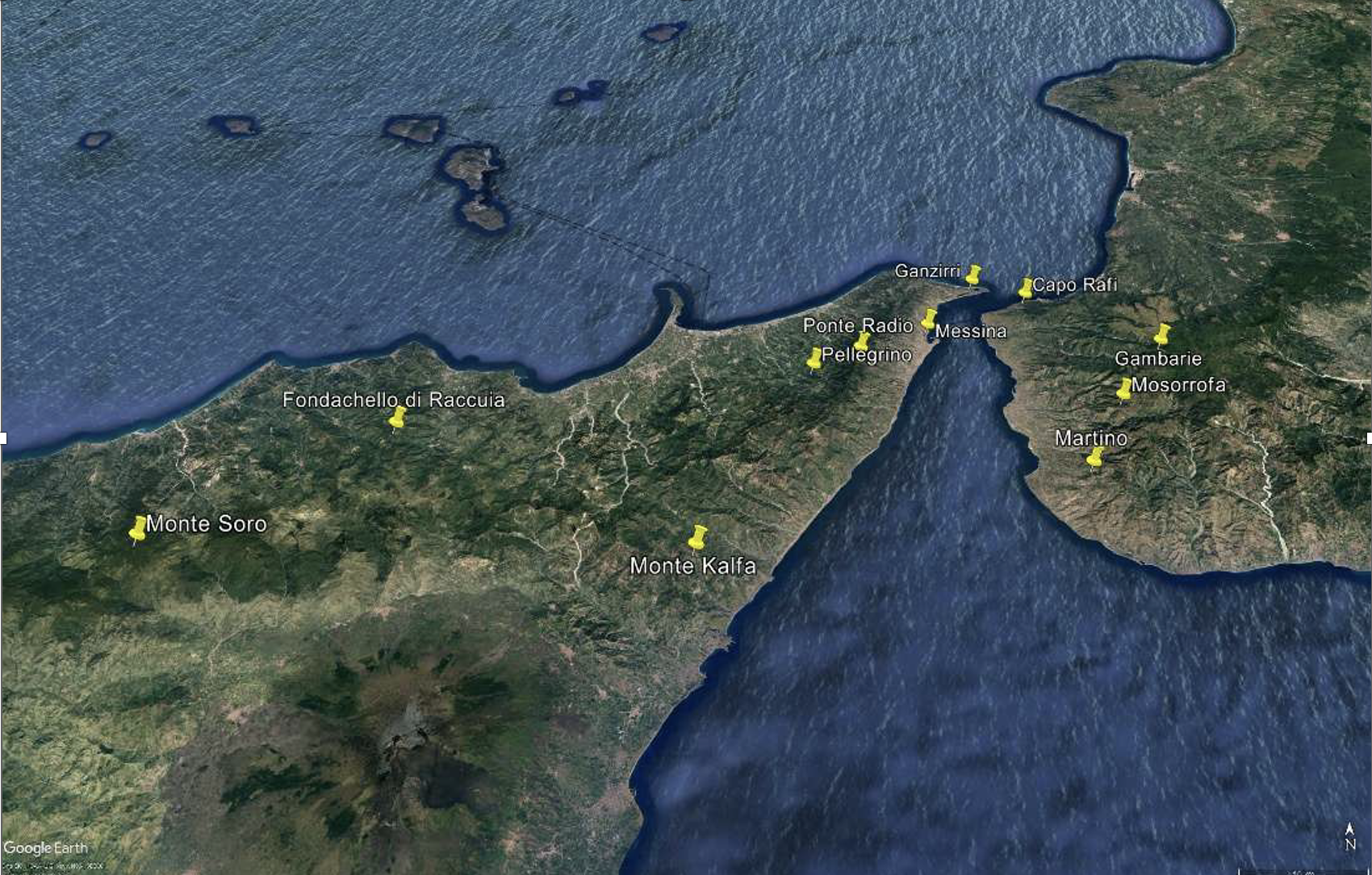
of the first peripheral stations installed in Messina, Ganzirri, Tremestieri, Martino, and Cannitello. The seismic
signals they generated were converted into an audible-frequency subcarrier modulated in frequency, which could then be
transmitted via UHF radio to the central observatory. The need to install stations on rocky outcrops, far from
anthropogenic noise and with direct radio visibility to the institute, highlights the engineering precision required to
build a fully analog telemetry network. The recording system, centred on the sophisticated Racal Geostore 14-track
magnetic recorder, ensured exceptional stability and accuracy. Reduced wow and flutter, together with built-in
electronic and mechanical compensation systems, allowed faithful reproduction of the seismic signal. Battery-buffered
operation permitted extended autonomy in the absence of mains power. The signals recorded on magnetic tape were later
demodulated and transferred onto paper by high-resolution oscillographs, enabling the precise temporal analyses needed
for epicentral localisation. During this period, time synchronisation was ensured by the DCF77 radio signal, derived
from a cesium standard, which aligned the time bases of all Italian and many European seismic networks.
Starting in the
mid-1980s, the network underwent a profound transformation towards digital technologies. The first step was the
introduction of a LeCroy analog-to-digital converter, interfaced with an IBM AT computer. Digitisation of the
telemetered analog signals made it possible to create hard-disk archives and to perform amplitude- and frequency-domain
analyses that had been impossible in the fully analog system. In parallel, the number of stations expanded to eleven,
extending coverage across Messina, Reggio Calabria and the Aspromonte. The new digital stations hosted three-component
seismometers oriented along the vertical, north–south, and east–west axes, greatly improving sensitivity and precision.
During the 1990s, the network reached its most advanced configuration, as summarised in the block diagram presented in
the documentation: an integrated system incorporating radio transmission, local digitisation, continuous DCF77
synchronisation, and centralised recording on hard disk with a modified video recorder as backup. The network, known as
the RSSM, became a national reference model for robustness, autonomy, and operational continuity. In the early 2000s,
the centralisation of seismic data acquisition by the National Institute of Geophysics and Volcanology (INGV) made the
maintenance of local networks increasingly difficult, and the RSSM was progressively decommissioned in 2003.
Today, the
RSSM stands as a crucial testament to the evolution of Italian instrumental seismology: a cultural and technological
transition that carried the field from mechanical analog systems to digital recording, anticipating the architecture of
modern seismic monitoring networks.
___
Antonino Marino, Domenica De Domenico, Maria Teresa Caccamo, Salvatore Magazù
References
Biondo, G, & Sacchi, E. (1983). Manuale di elettronica e telecomunicazioni. Milano: Hoepli.
Bottari, A., et al. (1985). Studio preliminare dello sciame sismico del maggio 1985 nello
Stretto di Messina.
Bottari, A., et al. (1993). Ampliamento ed ammodernamento della Rete Sismica di Messina.
Rodgers, P.W., et al. (1995). Signal Coil Calibration of E-M seismometers, BSSA.
___
___