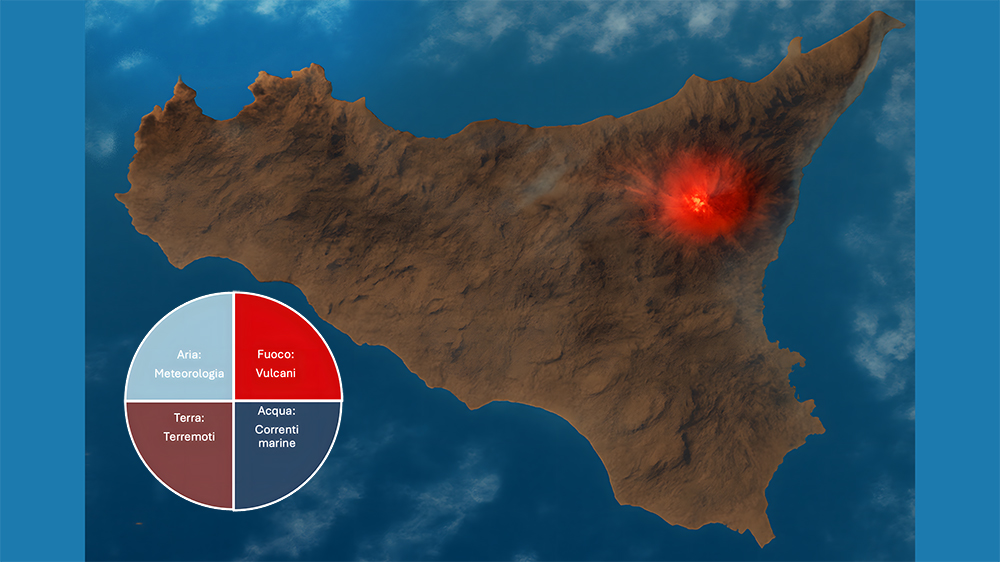
Aerial view of Sicily with Mount Etna in activity
2025
Credits: Magazù & Caccamo
SOUTH RISK
From data collection to monitoring intervention. A southern history
2025
Credits: Magazù & Caccamo
Empedocles and the Four Roots: Sicily as a Cosmic Laboratory of Nature
At the centre of the Mediterranean, Sicily appears as a crossroads of natural energies: trembling earth, shifting air, converging waters, and fire rising from the depths. Nowhere else, perhaps, does Nature reveal with such intensity the architecture of its elemental forces. It is no surprise that Empedocles of Akragas (5th century BCE), one of the earliest philosopher–scientists of the Western tradition, perceived in this landscape the living expression of the powers that generate the world. For him, everything that exists - minerals and living beings, atmospheric phenomena and geological -transformations - arises from the mixing and separation of four eternal principles: Earth, Water, Air, and Fire.
Air - Signs of the sky and wonders of light
In Sicily, Air is never a still element: it is a shifting, ever-changing medium capable of producing optical and meteorological phenomena of great fascination. The atmosphere of the Strait offers emblematic examples such as the lupa, the milky mist that rises from the sea and suddenly envelops the coastline, or the Fata Morgana, a complex mirage in which cities, arches, towers and ships seem to multiply and distort along the horizon. Today we understand the physical causes of these effects; in antiquity, however, such apparitions would naturally have found their place within the thought of Empedocles, for whom Air was one of the fundamental roots of reality: a subtle, mutable and permeable principle, capable both of transforming itself and of transforming human perception. In this sense, the atmospheric phenomena of the Strait still offer a vivid illustration of the dynamic nature that Empedocles attributed to the aerial element.Fire - Volcanoes as gateways to the depths
Earth is stability, structure, the body of the world. Yet it is also vibration, fracture and sudden change. Sicily embodies both aspects: from the lava plateaus that sustain cities and fields to the catastrophic 28 December 1908 earthquake, which devastated Messina and Reggio Calabria and claimed tens of thousands of lives. Empedocles, ever an observer of nature, would have interpreted such events as internal tensions of the element Earth, mutable in its equilibrium and its apparent stillness. Modern seismology confirms this intuition: Sicily is a complex tectonic junction in which plates and microplates interact intensely.Earth - The force that supports and that trembles
La Terra è stabilità, struttura, corpo del mondo. Ma è anche vibrazione, frattura, mutamento improvviso. La Sicilia conosce entrambe le dimensioni: dall'altopiano di roccia lavica che sostiene città e colture, al drammatico terremoto del 28 dicembre 1908, che devastò Messina e Reggio Calabria causando decine di migliaia di vittime. Empedocle, osservatore della natura, avrebbe letto questi eventi come tensioni interne dell’elemento Terra, mutevole nel suo equilibrio e nella sua quiete apparente. La sismologia moderna conferma questa intuizione: la Sicilia è un nodo tettonico complesso, in cui placche e microplacche interagiscono con intensità.Water - Currents, encounters and metamorphoses of the sea
For Empedocles, Water is the principle of cohesion and nourishment, but also of ceaseless movement. The Sicilian sea is among the most dynamic in the Mediterranean: in the Strait of Messina, the Ionian Sea meets the Tyrrhenian Sea, generating strong currents, whirlpools and flow reversals that alternate four times a day. Here myth and physics overlap: the turbulent waters between Scylla and Charybdis, which terrified ancient sailors, can today be interpreted as effects of density differences and tidal variations between the two basins. In this context, Water is not merely a surface but a force, a rhythm, a living breath of nature.From data collection to monitoring
interventions and
risk prevention
Project realized by:
University of Bari Aldo Moro
INAF - Astronomical Observatory of Capodimonte
University of Naples Federico II
University of Messina
PROGETTO SOUTH RISK © 2026 ALL
RIGHTS
RESERVED
The exhibition is realized for the project:prin
pnrr
South-Risk
From data collection to monitoring
interventions
and
risk prevention
A southern history
P2022TA5M8
