The 1730 eruption of Mount Vesuvius and Hauksbee’s thermometer
As a correspondent for Jurin's meteorological network, Niccolò Cirillo conducted intense
observation and data collection
in southern Italy from 1723 onwards, including observations of earthquakes and
eruptions.
The eruption of Mount Vesuvius in March 1730 attracted Cirillo's attention: he wrote a
detailed report, which he then
sent to the Royal Society. The report began with a comment on some critical issues
related to the use of Hauksbee's
thermometer, which Jurin had provided to all participants in his meteorological network
with the aim of standardizing
measurements and methods. Cirillo offered a possible explanation for the discrepancy
observed between the freezing
points of water in Naples and London, identifying its cause in the saline nature of the
air in Naples (very different
from that in London).
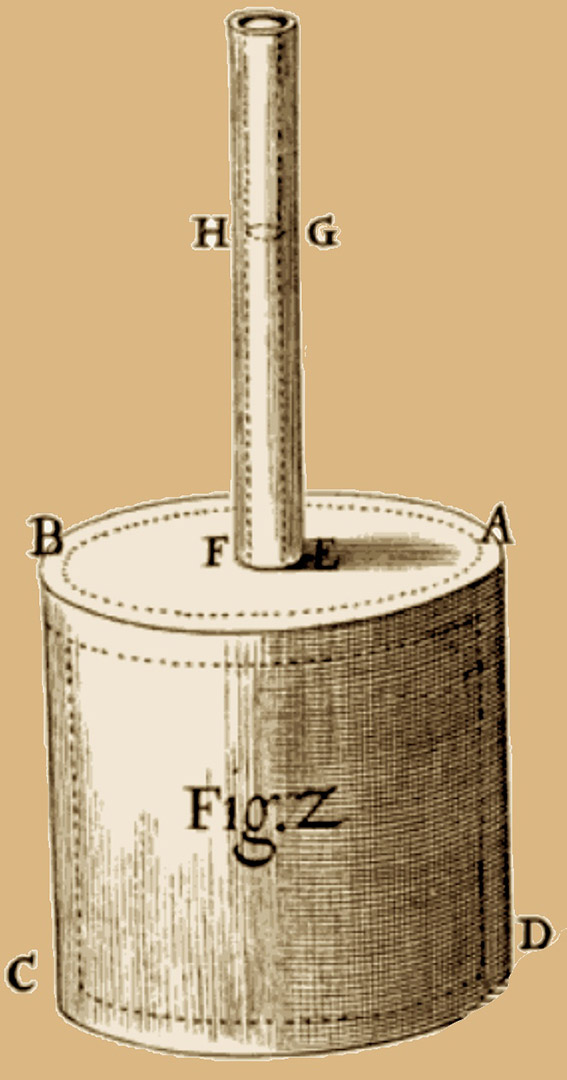
Hauksbee's first thermometer consisted of a long, thin tube, terminating at the lower
end in a hollow sphere filled with
wine spirits. The rarefaction and subsequent rise of the spirits could be estimated from
the number of divisions on the
tube, thus allowing the measure of the temperature of air or any other liquid. The tube
featured a scale with
twenty-three divisions, which alluded to the adoption of the original unit introduced by
Robert Hooke: this thermometric
unit, 1°H, was later found to be approximately equal to 2.4°C. Later, in 1720, Hauksbee
modified this standard, changing
Hooke's twentieth scale, which had its origin at the freezing point of water, to an
inverted centesimal scale, whose
unit was equal to one-fifth of Hooke's unit (and therefore approximately equal to
0.5°C).
After focusing on Hauksbee's thermometer, Cirillo went on to describe in detail the
eruption of Vesuvius, which
developed with the characteristics of an effusive Strombolian event and ended with the
collapse of its summit. In his
report, he also described the atmospheric conditions, which he believed were closely
related to volcanic activity.
___Salvatore Esposito & Adele
Naddeo
References
Cirillo, N. (1732). “An account of an extraordinary Eruption of
Mount Vesuvius in the Month of March, in the Year 1730,
extracted from the Meteorological Diary of that Year at Naples, communicated by
Nichol. Cyrillus”, Philosophical
Transactions of the Royal Society of London, 37 (424), pp. 336-338.
Patterson, L.D. (1951). “Thermometers of the Royal Society,
1663-1768”, American Journal of Physics, 19, pp. 523-535.
___
___