The 1783 Calabrian earthquake - 2
The seismic sequence that in 1783 hit Calabria and north-east Sicily marked the
beginning of
systematic studies aimed at
a deeper understanding of seismic phenomena and their causes. Many scientists focused on
peculiar effects induced by the
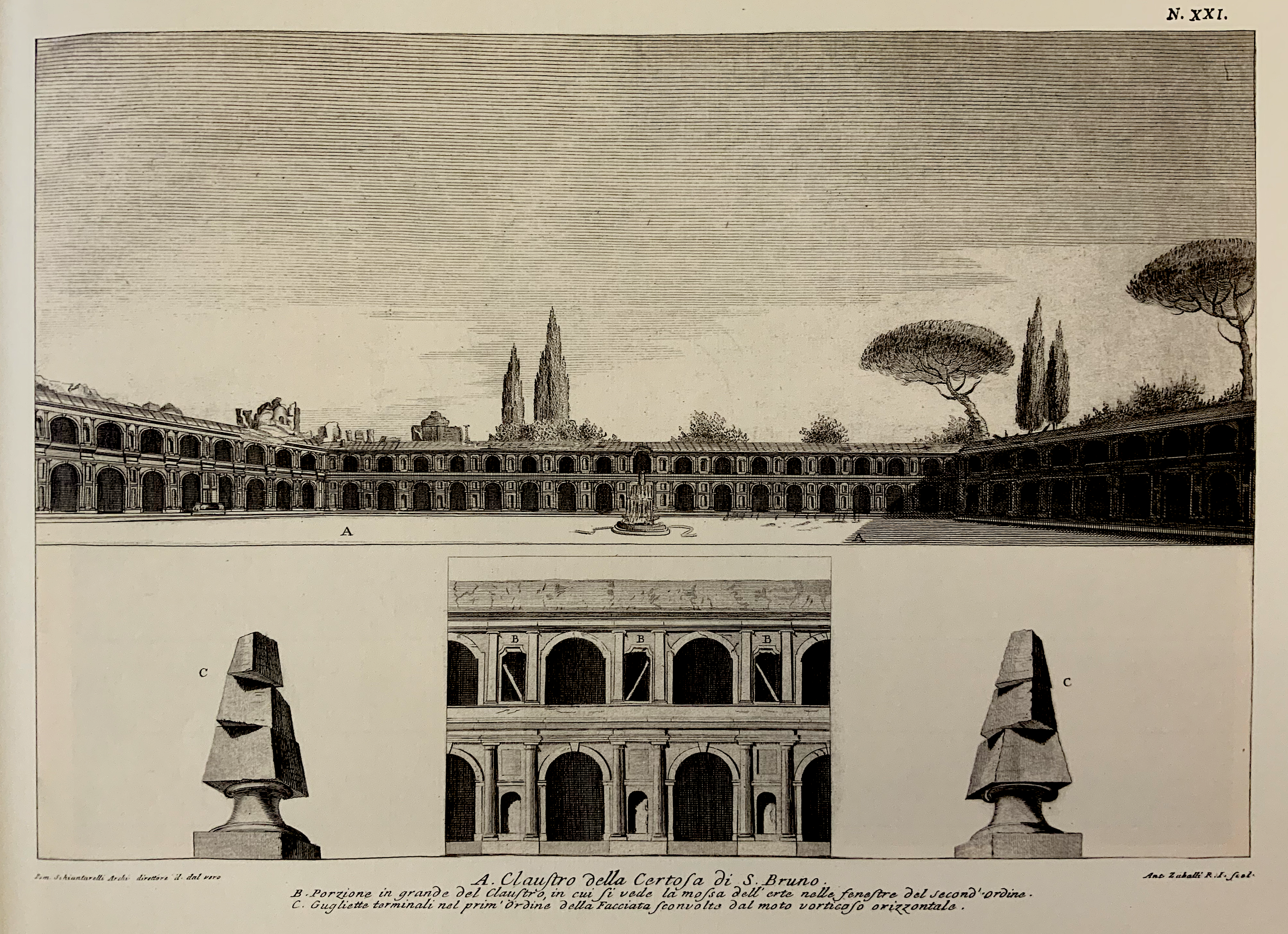
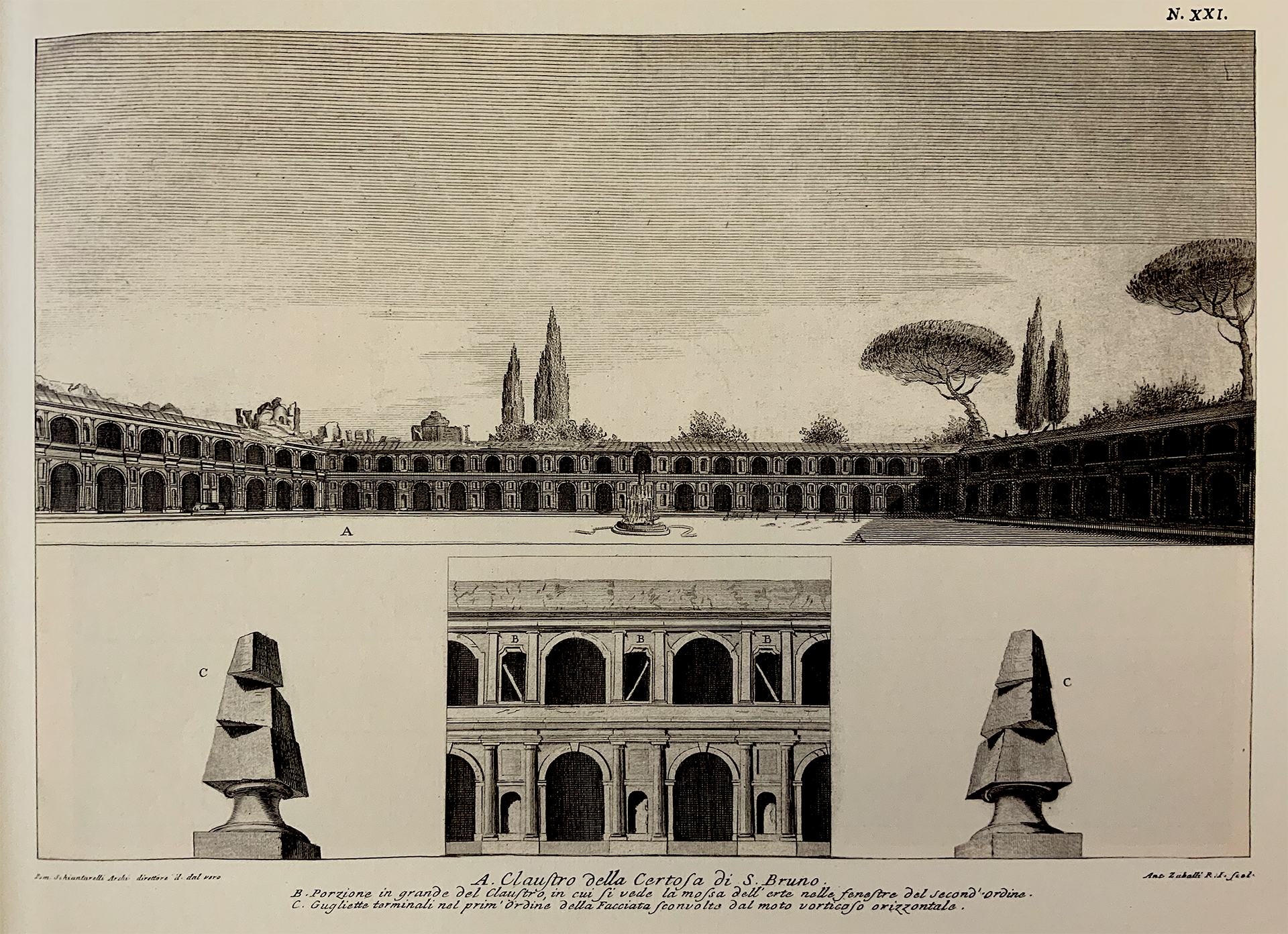
earthquake. Among them there was the opposite rotation of two obelisks at the
Charterhouse of
Serra San Bruno,
documented in the report of the seismological commission chaired by Michele Sarconi and
reproduced in a picture
contained in the enclosed atlas. This effect was mainly ascribed to vortical motions
eventually
associated with the
earthquake. Interestingly, in his Principles of Geology Lyell wrote: “It appears that
the
wave-like motions, and those
which are called vorticose or whirling in a vortex, often produced effects of the most
capricious kind. […] Two obelisks
placed at the extremities of a magnificent facade in the convent of S. Bruno, in a small
town
called Stefano del Bosco,
were observed to have undergone a movement of a singular kind. The shock which agitated
the
building is described as
having been horizontal and vorticose” (C. Lyell, 1830, p. 418). Later Robert Mallet
questioned
Lyell’s interpretation
and wondered how the earthquake shaking the ground back and forth could twist a stone.
He
considered a lower stone (for
instance the base of an obelisk) moving along a horizontal direction and identified the
source
of the opposite direction
of motion of an overlying stone in its inertia. Among all the possible undulatory
motions, the
only one able to displace
bodies by their inertia was then recognized to be “the transit of a wave of elastic
compression,
or of a succession of
these, in parallel or intersecting lines, through the solid substance and surface of the
disturbed country” (R. Mallet,
1848, p. 58). Mallet carried out an extensive study of earthquake waves, focusing on
their
velocity, amplitude and
wavelength, as well as on the effects of reflection and refraction when impinging on a
boundary
between rocks of
different density and elasticity properties,
___Salvatore Esposito & Adele
Naddeo
References
Lyell, C. (1830). Principles of geology, being an attempt to
explain the
former changes of the
Earth’s surface, by
reference to causes now in operation, vol. 1. London: John Murray, pp.
412-435.
Mallet, R. (1848). “On the dynamics of earthquakes; being an
attempt to
reduce their observed
phenomena to the known
laws of wave motion in solids and fluids”, The Transactions of the Royal Irish
Academy, 21,
pp. 51-105.
Ferrari, G. (2006). “Note on the historical rotation
seismographs”, in:
Teisseyre, R., Takeo,
M. & Majewski, E. (eds.),
Earthquake source asymmetry, structural media and rotation effects. Berlin:
Springer, pp.
367-376.
___
___
___
___